

Highly skilled migrants make a measurable contribution to Australia’s economic performance. This is reflected in recent evaluations and research published by the Australian Government. Accordingly, General Skilled Migration, which refers to visas granted through the points test without employer sponsorship, remains a central pillar of Australia’s migration policy.
The points test assesses applicants against defined criteria such as qualifications, age, English language proficiency and work experience. For the Skilled Independent visa, this points test is the core selection mechanism.
The role of the 189 visa and the need for reform
The subclass 189 visa plays a key role in Australia’s skilled migration strategy. Migrants selected through this pathway often bring qualifications and experience that contribute directly to economic growth.
In recent years, however, invitation rounds for the Skilled Independent visa were frequently difficult to predict. Long gaps between rounds, limited transparency and a lack of clear communication made program planning challenging and resulted in unrealised potential.
The current reforms focus on practical changes within the system: more regular invitation rounds, clearer occupational priorities and defined limits. Together, these measures are designed to make the selection process more transparent and predictable — to the benefit of the Australian economy and prospective applicants alike.
Key changes
Regularity of invitation rounds
One of the key changes relates to the frequency and predictability of invitation rounds. Instead of long, irregular gaps, invitations will now be issued in regular, announced rounds — for example quarterly — with the option of additional targeted rounds throughout the year.
Why this matters:
A predictable rhythm reduces the risk of backlogs building up in the SkillSelect pool, shortens waiting times and allows the administration to respond more quickly to changes in labour market demand. For applicants, this brings clear practical advantages: more predictable timelines, less uncertainty and a clearer understanding of when an invitation may realistically occur. It also enables the Australian Government to consider high-value applications promptly, rather than leaving them unused in the system for months. This measure is a core element of the Department’s operational efficiency strategy.
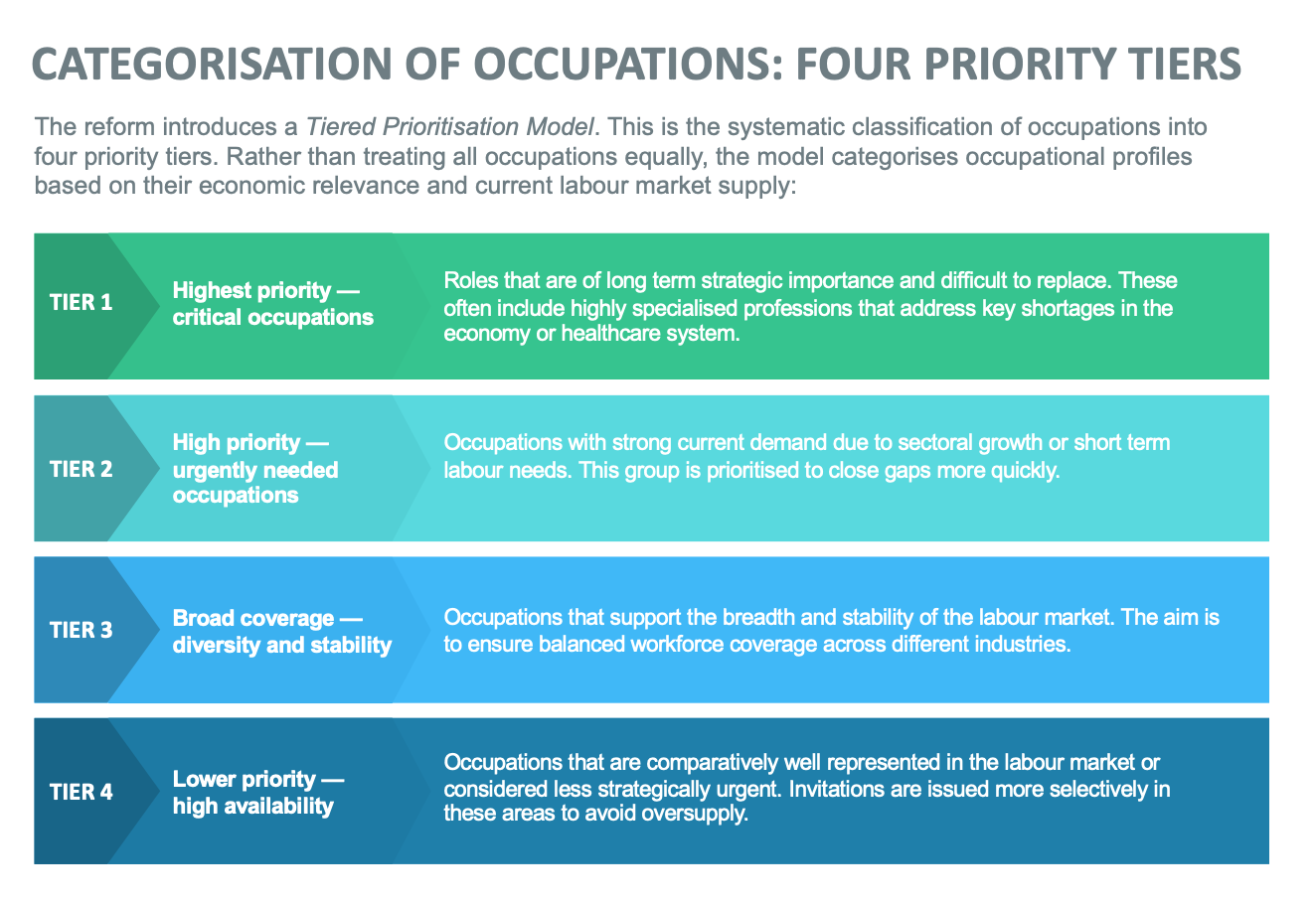
This classification has a direct impact on invitation prospects. Occupations in higher tiers receive a larger share of available places, while those with higher supply are subject to more selective invitation practices.
It is important to note that tier allocation is not permanent. Priority settings are reviewed regularly and may be adjusted in response to changing economic needs. This systematic prioritisation ensures that limited invitation places are allocated where they deliver the greatest long-term benefit.
Occupation ceilings — how available invitation places are determined
A central element of the reform is the introduction of binding occupation ceilings. These ceilings set the maximum number of visas that can be granted for a specific occupation in a given program year.
Crucially, these ceilings operate in conjunction with other visa pathways. Many visas are already granted through employer sponsorship, state or territory nomination, or regional programs. The subclass 189 pathway then receives only the remaining places available up to the occupation ceiling. In other words, the subclass 189 pathway fills any remaining capacity rather than creating additional, unlimited places.
Simplified calculation principle
- The occupation ceiling is calculated based on the existing workforce size (“stock”) of an occupation and multiplied by a factor that depends on its priority tier. The higher the priority tier, the higher the multiplier.
Visa grants issued through other programs are deducted from this ceiling. The remaining number represents the maximum places available under subclass 189 for that occupation.
Practical example
- In the occupation Early Childhood Teacher, 79,171 people were employed at the end of 2024–25. As a Tier-2 occupation, a multiplier of 2.0% applies, resulting in an occupation ceiling of 1,583 visa grants for 2025–26 (79,171 × 2.0 per cent).
In the previous year, 556 visas for this occupation were granted through other visa programs. This leaves 1,027 places available under subclass 189 for 2025–26 (1,583 minus 556).
This example illustrates that the subclass 189 allocation now follows a clear calculation logic and serves to fill remaining capacity up to the defined ceiling.
Operational management — monitoring and conversion rates
The reforms are accompanied by operational adjustments. Priorities and ceilings are not treated as rigid settings but as part of an ongoing management process. A key metric is the analysis of conversion rates, which measures how many invitations result in lodged applications and, ultimately, visa grants.
Based on these data, invitation volumes for subsequent program years are calibrated accordingly.
Regular monitoring, annual reviews and coordination with other government bodies are intended to prevent invitations from being issued but not used, while ensuring the system remains responsive to changing demand. This strategic management approach improves predictability for all stakeholders and reduces the risk of misalignment.
What this means for applicants — opportunities and challenges
For applicants, the new model offers several clear advantages:
- Greater predictability and reduced backlogs
Regular, announced invitation rounds limit excessive backlog growth and shorten waiting times. This is particularly beneficial for applicants with lower points scores. - More realistic assessment of invitation prospects
Clearer priorities and greater transparency make it easier to identify occupations with stronger prospects, reducing uncertainty and making it easier to plan strategically. - More targeted optimisation strategies
Improved predictability makes it easier for applicants to decide whether investing in improving their points score, for example by achieving a higher English test result, completing a NAATI credential or claiming partner points, is worthwhile. It allows applicants to better assess the potential return on that effort.
At the same time, the interaction between points scores, occupational tiering, ceilings and conversion rates makes a strategic approach more important than ever.
Conclusion — professional guidance remains valuable
The reforms to the Skilled Independent visa (subclass 189) represent a clear shift towards greater predictability, focus and transparency. Regular invitation rounds, occupation-based priority tiers and binding occupation ceilings with transparent calculation logic ensure that subclass 189 fills remaining capacity up to a defined limit.
For applicants, this means that access to accurate information, strategic assessment and, where appropriate, professional support has become increasingly important. If you would like to assess your prospects under the new system or develop a tailored strategy, we are happy to assist. Our registered migration agents provide tailored advice, a realistic assessment of your prospects and ongoing strategic support throughout the process.
