

Skills shortages remain a major issue in Australia. Australian migration law is structured accordingly and provides pathways to work visas and permanent residency for occupations in demand. A positive skills assessment is mandatory for the following visa subclasses:
- Skilled Independent (subclass 189)
- Skilled Nominated (subclass 190)
- Skilled Work regional (subclass 491)
- Skilled Employer Sponsored Regional (subclass 494)
ANZSCO Codes – Every Occupation Is Clearly Defined
Australia uses the Australian and New Zealand Standard Classification of Occupations (ANZSCO). Each occupation is assigned a six-digit ANZSCO code that defines its skill level and core tasks. These definitions form the basis for skills assessments and, ultimately, visa eligibility.
What Is a Skills Assessment?
A skills assessment is not part of the visa application itself but a mandatory prerequisite for lodging a visa application. Applicants who believe they qualify as a skilled worker for an occupation in demand must demonstrate this through a successful skills assessment.
It is a formal skills recognition process that assesses whether a non-Australian qualification meets the relevant Australian requirements and whether the applicant can therefore be regarded as a skilled worker under Australian standards.
Who Conducts the Skills Assessment?
Because the requirements vary significantly between occupations, the skills assessment is not carried out by the Australian Government itself, but by a Skills Assessment Authority responsible for the relevant occupation. These are typically professional associations, industry bodies, or specialised assessing authorities that have the necessary sector-specific expertise to assess individual requirements accurately and on a case-by-case basis. There is therefore no single central assessing body. Instead, there are approximately 40 different Skills Assessment Authorities, each responsible for different occupations. Which Skills Assessment Authority applies depends entirely on the nominated occupation.
What Are the Requirements for Skills Recognition?
Just as occupations differ, the requirements for an Australian skills assessment can also vary significantly. Each assessing authority may impose occupation-specific additional requirements beyond the official ANZSCO occupation definitions and determine which evidence is required for a successful assessment. Typical requirements include the following:
What Qualifications Are Required for a Skills Assessment?
Some Skills Assessment Authorities focus primarily on the underlying education and formal qualifications. This includes assessing the type of qualification obtained, the duration of the training or study, and the institution that awarded the qualification. In addition, the actual content of the qualification is assessed, including subjects studied, areas of specialisation, and whether practical components were included.
A positive skills assessment is therefore possible if it can be demonstrated that the qualification covered all components required under Australian standards.
Is Work Experience Required for a Skills Assessment?
Many assessing authorities require a minimum amount of work experience in addition to formal qualifications. In some occupations, extensive work experience may even compensate for the absence of a formal qualification.
Where practical experience is required for the occupation, the skills assessment will examine whether the applicant’s work experience is relevant and meets the required standards. This requires the submission of additional evidence, such as a résumé, employer references, and payslips.
For some occupations, it is not only the total number of years of experience that matters. In certain cases, recent work experience must also be demonstrated. In many cases, this means the experience must not be older than a specified period, often three years, and in some cases five or ten years.
It is also important to check whether there are minimum requirements regarding hours worked. This may require evidence of at least 20, 30, or 38 hours of work per week. If the employment was part-time, this may mean it is either not recognised at all or must be converted into a full-time equivalent.
Work experience gained through self-employment may also be recognised. However, the evidence requirements are usually more extensive, as formal employer references are typically not available.
Do I Need to Provide Evidence of English Proficiency for a Skills Assessment?
Not every skills assessment requires proof of English language proficiency. Proof of English proficiency is, however, mandatory for most skilled visa applications. For skills assessments, there are no uniform rules. English language evidence is often not required for trade occupations, but it is commonly required for health professions, engineering roles, and occupations in business and accounting. In these cases, an approved English language test must be provided.
It is important to carefully select the English test used. Not all Skills Assessment Authorities accept the same tests as those recognised by the Department of Home Affairs for visa purposes. It is therefore essential to check requirements in advance to avoid having to sit multiple English tests unnecessarily.
How Does the Skills Assessment Process Work?
For most occupations, the skills assessment process is entirely document-based. This means the required evidence is submitted and assessed based solely on the documentation provided. Typical documents include a résumé, qualification certificates, and employer references. The exact documents required depend on both the assessing authority and the nominated occupation.
For some occupations, a document-only assessment is not sufficient. Occupations that are subject to licensing in Australia often require additional assessments. This applies primarily to health professions and certain licensed trade occupations.
How Are Overseas Qualifications Assessed?
Most European countries use a national qualifications framework to classify qualifications and make them more comparable internationally. Based on the European Qualifications Framework (EQF), qualifications are typically assigned to consecutive levels from 1 to 8. This approach is also used in countries such as Germany and Austria.
Which qualifications are awarded, by which type of institution, and to which level they are assigned is determined individually by each country.
Many English-speaking countries have relatively similar education systems with comparable qualifications and requirements, which often makes mutual recognition more straightforward. This is not always the case for German qualifications. The education and training systems in German-speaking countries differ in many respects from the Australian system.
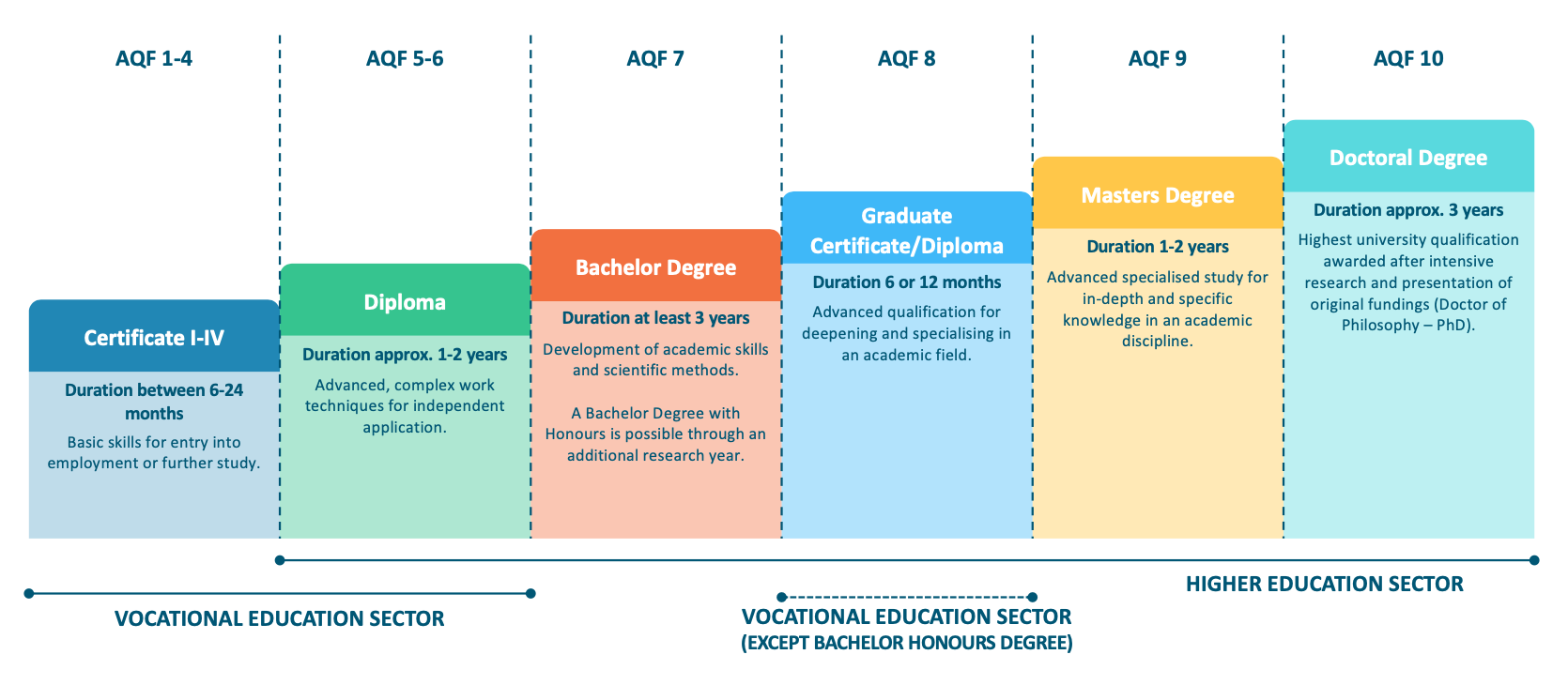
Australia also uses a national qualifications framework, the Australian Qualifications Framework (AQF). However, it differentiates between AQF levels from 1 to 10. This distinction alone is not decisive. Equally important is the sector in which a qualification was awarded. Certain AQF qualifications can only be obtained through providers in the Vocational Education and Training (VET) sector. Other qualifications can only be awarded by universities or higher education institutions within the Higher Education sector and therefore require an academic course of study.
This distinction is particularly important for skills recognition and often leads to situations where qualifications that may be classified at a similar level under the EQF are not considered equivalent if they were not completed within the corresponding sector. The details are therefore critical in the assessment process.
What Are the Most Common Issues and Pitfalls in the Skills Assessment Process?
Choosing the Correct Occupation
Each occupation listed on the Skilled Occupation Lists for visa purposes is defined individually. These official definitions are set out in the relevant ANZSCO code and include an overview of the typical tasks and duties associated with each occupation.
For a skills assessment, the decisive factor is therefore not the job title or how a position title may be translated, but whether the tasks predominantly performed in that role align with the official occupation definition and whether the required qualification level can be demonstrated.
In addition to the requirements set out in the ANZSCO definitions, the relevant skills assessment authorities may impose additional occupation-specific criteria. Applicants should therefore not limit their preparation to checking whether their job title appears on a skilled occupation list. Instead, they should carefully review the detailed occupation definitions and the additional requirements of the assessing authority before starting the application process. Once an application has been refused, it can often be difficult to remedy the situation.
Minimum Work Experience Requirements
For many occupations (though not all) the relevant skills assessment authorities require a minimum period of work experience. This must be paid and relevant employment that can be properly documented.
If an applicant has only recently completed their qualification or has worked in a different occupation after completing their training, this can cause issues for certain occupations. To avoid unexpected outcomes, it is essential to clarify the key requirements in advance.
Which Qualification Requirements Apply to My Occupation?
Each skills assessment authority determines which qualifications meet the minimum requirements for a specific occupation and whether a lack of formal qualifications may be compensated by other factors, such as extensive work experience. Applicants should therefore obtain detailed information in advance and carefully assess how their qualification is likely to be classified under Australian standards.
Common misunderstandings when assessing overseas qualifications:
Bachelor Degree vs Vocational and Advanced Professional Qualifications
Certain advanced vocational qualifications may be classified at EQF Level 6 in Europe and are therefore placed at the same level as a bachelor’s degree under European frameworks. This classification also applies to some advanced professional qualifications.
However, this is a national or regional classification that does not necessarily have international validity. Australia does not have equivalent qualification concepts. As a result, when assessing comparability, the primary focus is on the type of institution that awarded the qualification.
Under Australian standards, a bachelor’s degree is strictly an academic qualification that can only be awarded by a higher education institution following a multi-year course of study.
Registered Nurse vs Overseas Nursing Qualifications
Education and training in the health and nursing sector are structured differently in Australia compared to some overseas systems. In certain countries, a three-year vocational training program with a state examination may be sufficient to work as a qualified nurse. In Australia, however, a three-year university degree leading to a Bachelor of Nursing is required to work as a Registered Nurse and to obtain the necessary professional registration for this occupation.
Early Childhood Teacher vs Overseas Early Childhood Qualifications
In some countries, training as an early childhood educator is delivered through vocational education pathways. In Australia, the system differs. Early Childhood Teachers and Child Care Workers are responsible for the care and education of children in early learning and preschool settings.
For the occupation of Early Childhood Teacher — which offers more favourable visa options — Australian standards require a university degree in order to obtain skills recognition. Child Care Worker roles, by contrast, offer significantly fewer visa pathways.
Bookkeeper vs Accountant
Applicants who work as bookkeepers overseas and hold vocational or commercial qualifications do not necessarily meet the requirements for the Australian occupation of Accountant. This occupation requires a university degree with a strong accounting focus.
Those working in accounts payable or receivable roles may instead align more closely with the occupations of Bookkeeper or Accounts Clerk, which unfortunately offer far fewer visa options than the occupation of Accountant.
Conclusion
A skills assessment is an essential requirement for visas under the General Skilled Migration program. Only once a skills assessment has been successfully completed can the pathway towards a skilled visa be pursued. This is because such visas are intended exclusively for individuals whose occupation is one that Australia is unable to meet through its domestic workforce alone and for which it relies on migration.
The skills assessment process is always an individual assessment, and applicants bear the burden of proof. They must clearly demonstrate that they possess the specialised knowledge required for a specific occupation and can therefore be regarded as a skilled worker under Australian standards.
Education systems and occupational requirements differ significantly across countries, and qualifications are not always directly comparable. For this reason, assessments cannot be approached from a non-Australian perspective alone. Instead, it is essential to understand and apply Australian standards.
A skills assessment involves considerable time and cost. An unsuccessful outcome is therefore not only frustrating but can also result in unnecessary expense. To avoid costly mistakes, applicants should obtain accurate information in advance and, where appropriate, seek professional advice from a registered migration agent.
