

A SCHOOL YEAR FULL OF NEW EXPERIENCES
A school term or year in Australia is more than just time abroad — it offers valuable real-world experience that help students develop independence, open-mindedness and intercultural skills. Australia is known for its modern and practice-oriented education system, which focuses on individual support and real-life learning. For international students, the country offers a safe environment, strong student support services, and a wide range of academic and extracurricular activities.
Many families choose a full school year, a semester, or even just one term in Australia to give their child international educational experience. Whether as a classic high-school exchange with a host family, or as part of a family sabbatical where the entire family spends time in Australia – the options are varied and can be arranged flexibly.
On this page, you’ll find information about:
- School system in Australia
Australia’s education system is considered one of the best worldwide and is clearly structured. Australia has a nationally recognised curriculum, with implementation overseen by each state and territory. As a result, there are minor differences in terminology and final certificates, but the overall structure remains comparable across the country.
Children usually start school at the age of five to six. After Year 10, students decide whether to complete a vocationally oriented school certificate or continue on to Year 12 to obtain the Senior Secondary Certificate.
The system is divided into two main stages:
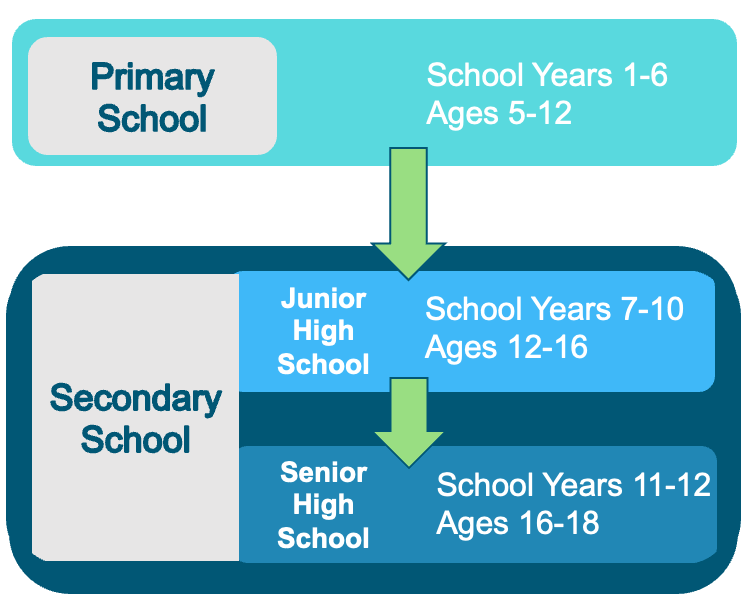
School year
The Australian school year begins in January and is divided into four terms – with short breaks in between and a longer summer break over Christmas. This structure allows flexible entry points for international students, such as one term (around 10 weeks), a semester (two terms), or a full school year.
- Public Schools: Government schools are generally more affordable and well-equipped. They accept international students through dedicated programs.
- Private Schools: Private or independent schools often offer specialisations – for example in music, science, languages or sport – and usually provide excellent facilities and pastoral care.
In Australia, students can attend both government schools (“public schools”) and private or independent schools. Regardless of school type, international students benefit from high academic standards and teachers with extensive experience supporting overseas students.
School types
Australian schools usually run as full-day schools. Classes typically run from around 9:00 am to 3:00 pm. Alongside core subjects such as English, maths and science, students are encouraged to pursue personal interests. A wide range of elective subjects is offered, including art, music, design, drama, languages, sport, media or business.
A distinctive feature of many Australian schools is the concept of “School Houses”, similar to the UK. Students belong to a “house”, which acts as a social team. Regular sporting and cultural competitions take place between the houses – an important part of Australian school life that fosters team spirit and community.
Sport and extracurricular activities play a central role. Whether swimming, surfing, athletics, horse riding or team sports – physical activity is an essential part of school life. Many schools also run clubs for music, theatre, environmental projects or community service.
Australian schools place strong emphasis on independent learning. Students are encouraged to ask questions, think critically and work autonomously rather than simply memorise content. Modern teaching methods, digital learning tools and project-based learning shape everyday school life.
Everyday school life
Quality
Australia places great emphasis on quality assurance in education. Through the Education Services for Overseas Students (ESOS) Act, the government ensures reliable standards and fair conditions for international students. This makes Australia not only an attractive but also a trustworthy study destination – from primary school through to university.
Options for
International Students
Options for
International Students
in Australia
Schooling in Australia is generally open to international students of all ages. Australian schools are experienced in hosting students from around the world and offer flexible short- and long-term programs. It is essential that appropriate accommodation and supervision are guaranteed – either through a host family (homestay) or, for younger children, through an accompanying parent.
International students can structure their school stay in various ways:
Family sabbatical – school attendance with a parent
More and more families are choosing to experience the school period in Australia together. While the children attend an Australian school, parents use the time as a family sabbatical to get to know the country, lifestyle and culture in depth.
Depending on the situation, various visa options may be suitable – for example a Guardian Visa, which allows one parent to accompany and supervise the children, or temporary work or student visas if the stay is also intended for personal or professional development.
This option makes it possible to combine the children’s school attendance with a shared family break – ideal for parents who want to experience Australia not only as a travel destination, but as a temporary home.
A family sabbatical in Australia life brings together education, life experience and family time – a unique opportunity to grow together beyond everyday.
Family sabbatical
A school year with a host family
A stay of one semester or a full school year is the classic form of attending school in Australia. Teenagers typically between 14 and 18 years old attend an Australian high school during this time and usually live with a host family (homestay).
A longer stay makes it possible to develop English skills at a high level, build international friendships and truly experience Australian school life. In addition to linguistic progress, this experience promotes independence, open-mindedness and personal maturity.
Many students deliberately choose to spend a semester or a full year at an Australian school during their senior secondary years to broaden their future opportunities and gain valuable intercultural skills. Such a stay often becomes a formative life experience – academically, linguistically and personally.
A high school year in Australia is therefore far more than a school stay – it is an experience for life, one that opens horizons and has a lasting impact.
A high school year in Australia is far more than a school stay – it is an experience for life, one that opens horizons and has a lasting impact.
Student Visa
Family sabbatical – school attendance with a parent
More and more families are choosing to experience the school period in Australia together. While the children attend an Australian school, parents use the time as a family sabbatical to get to know the country, lifestyle and culture in depth.
Depending on the situation, various visa options may be suitable – for example a Guardian Visa, which allows one parent to accompany and supervise the children, or temporary work or student visas if the stay is also intended for personal or professional development.
This option makes it possible to combine the children’s school attendance with a shared family break – ideal for parents who want to experience Australia not only as a travel destination, but as a temporary home.
A family sabbatical in Australia life brings together education, life experience and family time – a unique opportunity to grow together beyond everyday routines.
Family sabbatical
Why Australia is particularly suitable
Australia offers excellent conditions for international students:
- Schools with long-standing experience hosting international students
- Professional support services and vetted host family networks
- Flexible start dates at the beginning of each term and individually planned durations
- Modern learning environments and a diverse range of extracurricular activities

Questions? We have
the answers!
OPTIONS FOR A
FAMILY SABBATICAL
OPTIONS FOR A
FAMILY SABBATICAL
in Australia
Family sabbatical in Australia – living, learning and exploring together
Many parents do not want to send their child to the other side of the world for months without being able to see where they live and attend school. For this reason, more and more families choose to combine the school experience with a shared time in Australia.
A longer stay “Down Under” allows families to combine education, travel and family time. While children attend school, parents can take a break from everyday life, gain new perspectives and experience Australian life up close.
Depending on duration, goals and personal circumstances, different visa pathways can enable such a sabbatical. Australia offers several visa options that allow families to travel together and live in the country temporarily.
Whether as a short stay on a Visitor Visa, with a Student Guardian Visa for the accompanying parent of a school-aged child, or with a Student Visa for the whole family – each option has its own requirements and possibilities.
The overview below outlines the available pathways and how they differ.
Overview of the different options
- Visitor visa for the whole family
For shorter school stays – such as one term or a language and cultural program of up to three months – a Visitor Visa is often sufficient. Depending on how long the family intends to stay in Australia (only for the school period or also for a subsequent holiday), both the eVisitor Visa and the Visitor Visa can be used.
Children may attend an Australian school for up to 3 months, provided the chosen school accepts students on Visitor Visas.
Parents can travel to Australia with the same visa. This allows families to spend the stay together, parents can complete a short course or English program of up to three months (as the visa also grants a three-month study permit), and the entire stay can easily be combined with a family holiday.
Particularly suitable for families who…
- ...want to get to know Australia without committing long-term.
- …want to give their child a short insight into Australian school life.
- …want to combine school attendance with a holiday.
- …prefer a simple, flexible option with minimal formal requirements.
Important: The Visitor Visa does not grant work rights – the stay must be purely tourist or study-related.
- Student Guardian Visa for one parent
For longer stays – such as a semester, a full school year or even longer – a combination of a Student Visa (subclass 500) for the child and a Student Guardian Visa (subclass 590) for an accompanying guardian is appropriate. This arrangement allows one parent or legal guardian to accompany the child during the school stay in Australia and take responsibility for care, accommodation and support.
The visa applies for the entire duration of the child’s school program and is specifically designed for students under the age of 18. It does not include work rights but allows participation in an English course of up to three months.
Particularly suitable for parents who…
- …want to accompany their child personally throughout the school stay.
- …prioritise supervision, family life and shared time.
- …want to refresh their own English skills in Australia.
- …want to turn the overseas stay into a shared family experience.
Important: The Student Guardian Visa is only available for one parent and does not include work rights.
- Student Visa for the entire family
Families wishing to combine the stay with further education or vocational training can also do so by having one parent enrol in a suitable full-time program. In this scenario, the parent applies for the Student Visa (subclass 500) as the main applicant, and children (and optionally a partner) can be included as dependants. This allows school-aged children to attend an Australian school without requiring their own student visa.
Another advantage: the Student Visa grants part-time work rights for both the student parent and their partner, allowing a flexible combination of study, family time and travel.
Particularly suitable for families who…
- …want to use the stay for their own professional development.
- …prefer a more independent structure for the family sabbatical.
- …would appreciate the option of part-time work during their stay.
- …want an intensive experience of Australian life as a personal and professional opportunity.
Important: The Student Visa requires enrolment in an eligible full-time on-campus course.
FREQUENTLY ASKED QUESTIONS - FAQS
SCHOOL STAY IN AUSTRALIA
FAQS

01 How old do you need to be for a school year in Australia?
Students of all ages can attend school in Australia, including from primary school onwards.
Most commonly, teenagers aged 14–18 spend one or two terms at a high school. Appropriate supervision must be ensured – either through a host family or an accompanying parent.
02 Do you need permission from your home schoolman school to take leave?
Yes. If the stay falls outside the regular holiday periods, a formal leave of absence must be approved before travelling to Australia. This is usually granted by the school administration or relevant authority and depends on the state-specific regulations.
03 How does the stay abroad affect schooling at home?
Many schools recognise achievements made abroad or allow students to advance on probation. However, no unified rules exist – the decision lies with the school or the education authority. Therefore, it is important to clarify how the stay fits into the individual school pathway and what documentation is required.
Important points to clarify include:
- Timing and year level: Students in academically focused programs often choose the early senior years; students in general secondary pathways commonly select Year 9 or 10.
- Recognition of results: There is no automatic entitlement – recognition is decided individually.
Recommendation: Speak with the school early, coordinate subject choices and performance documentation, and clarify which documents are necessary for recognition.
04 When is the best time for a school stay in Australia?
The ideal time depends on the student’s school pathway at home. For many students, the start of senior secondary school (Year 10 or 11) is a typical entry point; for others, Year 9 or 10 may be suitable.
The Australian school year consists of four terms of around ten weeks each, beginning in January. Entry is usually possible at the start of any term, which supports integration and steady learning progress.
Points to consider:
- Avoid starting too late in the year: The final term (October–December) is exam season.
- Consider the seasons: In Australia, the seasons are reversed compared to the northern hemisphere. In southern states it can be cool and rainy in July, while Queensland offers mild temperatures all year.
- Flexible durations:
- One term (10 weeks) – ideal for a first experience
- One semester (two terms) – balanced option
- Full school year (four terms) – best for language development and authentic everyday experience
The longer the stay, the deeper the personal and linguistic development – friendships, independence and cultural awareness grow significantly.
05 How long can students attend school in Australia?
This depends entirely on personal goals:
Some prefer a short stay to get a first impression of Australian school life. Others opt for a full school year – or multiple years – to fully immerse themselves in the Australian lifestyle and explore the country and culture in depth.
06 Host family or family sabbatical?
For many students, living with an Australian host family (homestay) is the classic and most enriching form of stay.
Host families are carefully selected and supported by the school. For underage students, the school issues a Confirmation of Appropriate Accommodation and Welfare (CAAW) – an official document confirming that accommodation and care meet regulatory requirements.
Students with relatives or close family friends in Australia may also stay with them under certain conditions.
Alternatively, many families choose a family sabbatical: a parent accompanies the child to Australia – usually with a Student Guardian Visa – and takes care of supervision and daily life. This option allows families to experience the stay together.
07 What costs should be expected for a school stay in Australia?
School attendance in Australia is fee-based. Costs depend on whether one chooses a public or private school and which region is preferred. Additional expenses include accommodation, flights, health insurance (OSHC) and the visa.
08 Can the stay be organised independently, or is an organisation required?
Both are possible.
Those who prefer a convenient package can use specialised exchange organisations.
Families organising independently contact the Australian school directly, obtain the Confirmation of Enrolment (CoE) and then apply for the Student Visa (Subclass 500). Australian schools have experienced staff who assist with enrolment and host-family arrangements.
09 Which visa is required for students?
This depends on the specific plan.
For stays of up to three months, a visitor visa may be sufficient. For longer school stays, a Student Visa (Subclass 500) is required. If a parent travels as a guardian, they also need a visa (usually the Student Guardian Visa).
10 Are there regions that are particularly suitable for students?
Australia is considered one of the safest and friendliest countries for international students. The choice of region depends on personal preferences.
Major cities like Sydney, Melbourne and Brisbane offer extensive recreational opportunities, while smaller cities and regions such as Queensland, Tasmania or South Australia are often more personal and affordable. Students who love nature, beaches and outdoor activities will find great options everywhere.
SUPPORT FROM VISAPATH
As an Australia-based migration agency, Visapath supports families planning a school stay in Australia. We advise individually on visa options (e.g. Student Visa or Visitor Visa), the legal requirements around accommodation for minors – including stays with relatives or host families – and on planning a family sabbatical with an accompanying parent.
Our consultants understand the requirements for international students and family stays in Australia.

Service and quality advantages with Visapath
- Dedicated personal contact: Personal support from one advisor throughout the entire application process – from initial enquiry to visa grant.
- Expert guidance by Migration Agents: Every application is handled by a registered Migration Agent – experienced, qualified and legally authorised.
- Transparent procedures & highest standards: We adhere to strict Codes of Conduct in Australia that guarantee data protection, transparency and professional integrity.
- Complete service from one source: We take care of consulting, translation management and visa processing – coordinated, efficient and reliable.