
Home » Visa categories » Australia » National Innovation Visa
National innovation Visa
For innovators, entrepreneurs, investors and researchers who want to help shape Australia’s future with their ideas and expertise.

THE AUSTRALIAN NATIONAL INNOVATION VISA
For successful innovators, investors, entrepreneurs, researchers, creatives and athletes.
On this page:
- Who the visa is designed for
- How the application process works
- What the visa allows you to do

AUSTRALIA’S VISA FOR TOP TALENT AND INNOVATORS
The National Innovation Visa (Subclass 858) is designed to attract globally recognised, highly successful professionals, entrepreneurs, academics and innovators who are leaders in their field. This visa offers a direct pathway to permanent residency in Australia and is aimed at people who can significantly advance the country in key sectors.
The National Innovation Visa is an evolution of the former Global Talent Visa. It enables outstanding professionals to establish themselves in Australia and grow within an innovation-friendly environment. The program focuses on top talent in industries that are critical to Australia’s economic and technological future.
With this permanent visa, you can not only live and work in Australia, but also bring your family and benefit long term from the country’s high quality of life.
VISA REQUIREMENTS AND PROCESS
The National Innovation Visa does not follow a rigid points system – it focuses on people, not checklists. What matters are achievements, impact and potential, not formal thresholds. The process is deliberately flexible and focused on excellence, and therefore discretionary: each application is assessed in its entirety. You do not need an employer or job offer. Applicants who meet the criteria can be granted permanent residency straight away – for themselves and their family.
The visa is based on your previous work, research and achievements, and Australia expects that you will continue to work in your field and contribute to the country in that area. However, there are no mandatory conditions requiring you to take specific actions – the visa gives you complete flexibility.
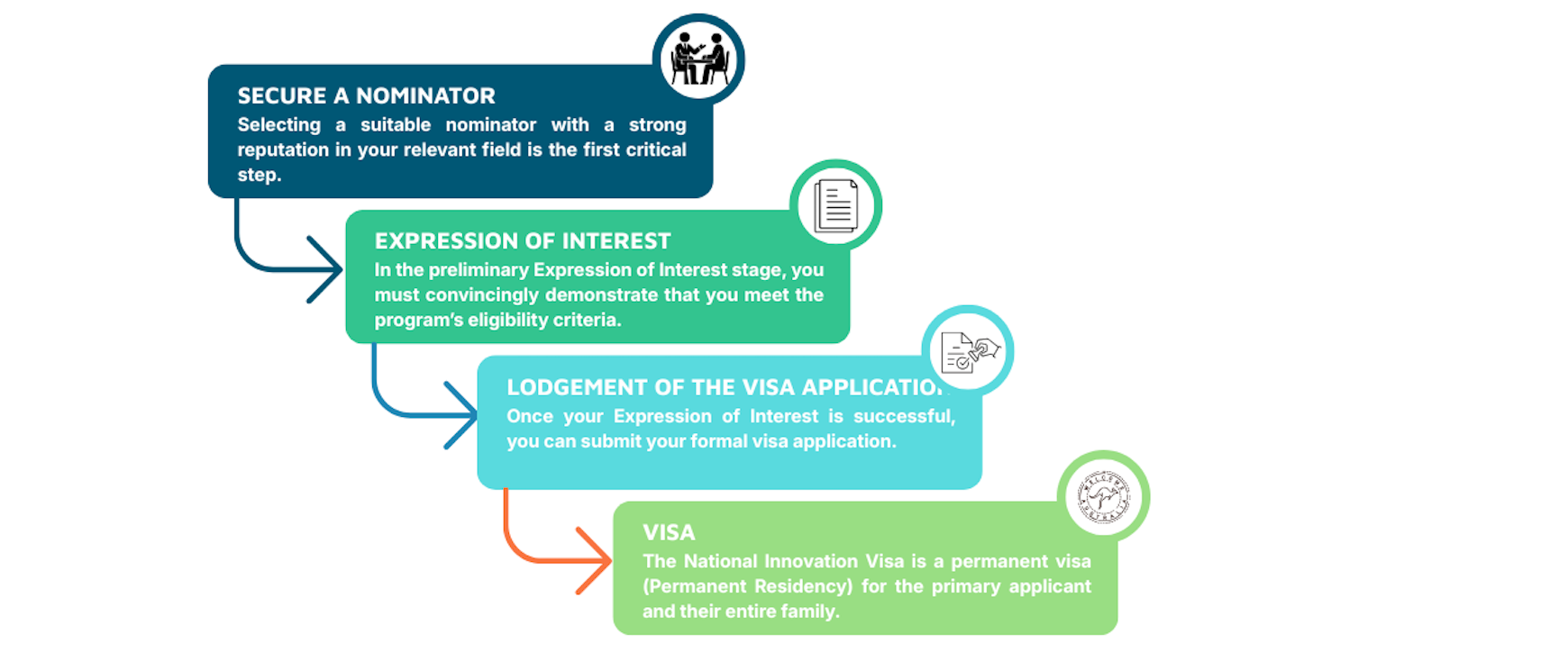
The pathway to this visa generally involves two steps:
- First you submit an Expression of Interest (EOI) to present your profile.
- After receiving an invitation, you lodge the actual visa application.
- Requirements
- Invitation: Application only after an Expression of Interest (EOI) and invitation from the Department of Home Affairs
- Nomination: Required from an Australian individual or organisation with national standing in the relevant field, or from an Australian state or territory government
- Track record: International recognition and outstanding achievements in your profession, research, sport or creative field; activities must be current and relevant
- Age: No fixed upper age limit; applicants over 55 must demonstrate a particularly strong benefit to Australia.
- English: At least functional English
- Must meet the general health and character requirements
- Family: Partner and dependent children can be included in the application
- Process
First, you need to identify a suitable nominating person, organisation or state/territory. While the nomination is not always strictly required at the EOI stage, it should be secured as early as possible – without a nomination, a visa application cannot be lodged.
Next, you submit the Expression of Interest (EOI).
If you then receive an invitation, you proceed with the actual visa application to the Department of Home Affairs.
Applicants seeking a state nomination (for example from New South Wales or South Australia) must first complete a separate EOI process with the relevant state or territory to obtain that nomination.
- Priority Groups
For the National Innovation Visa, outcomes are not determined by the order in which EOIs are lodged, but by the priority group your profile is placed into.
The Department of Home Affairs uses four Priority Groups (1–4) to assess Expressions of Interest.
The higher the priority group, the stronger your chances of receiving an invitation to apply for the visa. Allocation is based on your qualifications, awards, fields of activity and – where applicable – state or institutional nominations.
In other words: the priority group largely determines the likelihood of your EOI being successful – and is therefore the key lever in the whole process.
- Priority 1: Exceptional individuals with globally recognised, world-class achievements
- Priority 2: Applicants nominated by an Australian government body (Commonwealth, state or territory)
- Priority 3: Applicants with proven excellence in Tier-1 sectors (“Critical Technologies, Health Industries, Renewables and low emission technologies”)
- Priority 4: Applicants with expertise in Tier-2 sectors (“Agri-food and AgTech, Defence Capabilities and Space, Education, Financial Services and FinTech, Infrastructure and Transport, Resources”)
Tier 1 Sektoren

01 Critical Technologies
Potentially transformative enabling technologies.
This sector includes, in particular, areas such as artificial intelligence, advanced robotics and cyber security technologies.
It covers – but is not limited to – the following specialisations:
Advanced information and communications technology
Advanced manufacturing and materials technologies
Artificial intelligence (AI)
Autonomous systems
Biotechnology
Clean energy generation and energy storage
Cyber security technology
Quantum technologies
Photonics
Robotics
Positioning, navigation, timing and sensor technologies
02Renewables and Low-Emission Technologies
Technologies that support Australia’s pathway to net zero.
This sector covers innovations that enable and accelerate the transition to a carbon-neutral economy.
It includes – but is not limited to – the following specialisations:
Biomethane production
Circular-economy innovations
Clean energy technologies
Emissions reduction and carbon capture/storage
Green metals
Low-carbon liquid fuels
Processing and refining of critical minerals
Renewable energy generation
Transmission, distribution and storage of energy
Renewable hydrogen
Waste-to-energy (WtE) technologies
03Health Industries
Innovation in medical manufacturing and strengthening national capability in medical research.
This sector focuses on technologies and developments that secure Australia’s independence and competitiveness in medical science and production.
It includes – but is not limited to – the following specialisations:
Tackling antimicrobial resistance
Artificial intelligence in healthcare
Biochemistry and cell biology
Biotechnology
Genomics
Responding to emerging health threats and emergencies
Health economics
Implantable and wearable medical devices
Prevention of infectious diseases
Pharmacy and precision medicine
Medical manufacturing for therapeutic products
Tier 2 Sektoren

01 Agri-Food and AgTech
Innovation and value-creation in agriculture, forestry and fisheries.
This sector covers technologies and processes that lift productivity, sustainability and competitiveness in the agri-food sector.
It includes – but is not limited to – the following specialisations:
Biotechnology
Biosecurity and disease management
Farm management technologies
Food technology
Processing of primary products into higher-value goods
Innovation and sustainability in agriculture, forestry and fisheries
Manufacture of products used in or closely linked to primary industries
02 Education
Academic teaching, research and management at universities and higher education institutions.
This sector covers senior and top-level roles in higher education and research that contribute to international excellence and the strategic development of the education sector.
It includes – but is not limited to – the following specialisations:
Senior management roles at universities and higher education institutions
Professorial positions
03 Defence Capabilities and Space
Strengthening national defence and space capabilities.
This sector supports technologies and capabilities that secure Australia’s strategic independence and competitiveness in defence and space.
It includes – but is not limited to – the following specialisations:
Development, manufacture and maintenance of products that contribute to defence capability
Electromagnetic technologies
Propulsion systems
Space objects
Space systems engineering
Key skills and expertise supporting the space industry
04 Financial Services and FinTech
Promoting innovation in financial services and financial technology.
This sector focuses on technological developments that improve efficiency, security and competitiveness in the finance and IT industries.
It includes – but is not limited to – the following specialisations:
Innovation in application development (application programming)
Blockchain engineering
Cloud technologies
Cyber security and data protection in the FinTech space
Financial data analytics and data science
Software development and engineering
05Infrastructure and Transport
Driving innovation in the transport sector and in infrastructure projects.
This sector covers technologies and projects that promote mobility, efficiency and sustainability in transport and infrastructure.
It includes – but is not limited to – the following specialisations:
Innovative manufacturing processes and technologies that advance the transport sector
Large-scale and complex infrastructure projects for roads, bridges, tunnels, rail infrastructure and airports
06 Resources
Innovation, product development and value-creation in the resources sector and in supply chains for critical minerals.
This sector strengthens Australia’s position as a leading resources nation through technological innovation, efficiency gains and sustainable processing.
It includes – but is not limited to – the following specialisations:
Automation and Industry 4.0 capabilities
Beneficiation technologies
Critical and battery minerals
Exploration services
Geology and metallurgy
Decommissioning and dismantling of oil and gas infrastructure
Waste management in the resources sector
Value-adding and manufacture of products and technologies that advance mineral processing
PRIORITY 2 GROUP – APPLICANTS WITH STATE NOMINATION
The Priority 2 Group includes applicants who have been formally nominated for the National Innovation Visa by an Australian state or territory government. It is aimed in particular at:
- Athletes, creatives and innovators who enhance Australia’s international reputation in their field.
- Investors who have demonstrably (and repeatedly) invested in successful start-ups or technology projects.
- Promising entrepreneurs whose ventures have strong commercialisation potential in Australia.
- Recognised IP ownership, for example international patents personally held by the applicant.
TARGET GROUP: RESEARCHERS AND ACADEMICS
This target group includes leading scientists and academic thought leaders whose outstanding research and international recognition show that they belong to the top of their discipline.
This includes, among others, recipients of major national or international research grants such as:
- Funding from the Australian Research Council (ARC) or the Department of Education’s Accelerator Program,
-
Equivalent research grants from overseas, for example UK Research and Innovation, the European Commission or the US National Science Foundation
Also included are PhD holders with demonstrably high scientific impact and thought leadership – for example evidenced by:
- Publications in leading international journals such as Nature, The Lancet or Acta Numerica
- A high h-index relative to career stage (for example 14 for early-career researchers)
- A research degree from a globally leading university ranked in the top 100 worldwide (Times Higher Education).

HOW VISAPATH SUPPORTS YOU WITH THE NATIONAL INNOVATION VISA
The National Innovation Visa is aimed at exceptional individuals with outstanding achievements. To ensure your profile stands out in the selection process, you need a clear strategy, a well-structured narrative and flawless execution – that’s exactly where we support you.
1. Finding a Nominator
To qualify for the National Innovation Visa, you need the support of a recognised organisation, a leading figure in your industry or an Australian state or territory. This nominator plays a key role, as they officially confirm your international achievements and your ability to contribute to Australia’s economy or society.
How we help:
- Selecting a nominator: We advise you on suitable nominators and can assist with Expressions of Interest for state nominations.
- Preparing documentation: Where needed, we prepare all required documentation for applications to selected institutions or state governments.
2. Lodging an Expression of Interest (EOI)
The EOI is the first step in the application process. This is where you present your skills, achievements and plans. Your EOI must be compelling, because only applicants who stand out receive an invitation to lodge the actual visa application. The number of places available each year is limited. It is a competitive process in which the quality of your submission is crucial.
How we help:
- Preparing a tailored EOI: We draft your EOI so that it showcases your skills and goals as clearly and convincingly as possible.
- Strategic advice: We ensure all relevant criteria are addressed and your strengths are clearly highlighted.
- Review and refinement: Before submission we review and fine-tune your EOI in detail.
3. Invitation to Apply
Only applicants whose EOI meets the requirements and who are considered suitable by the Australian Government receive an invitation to lodge a visa application. This invitation is essential – without it, you cannot move to the next stage.
4. Lodging the Visa Application
After receiving an invitation, you submit the formal application for the National Innovation Visa. At this stage you must provide extensive evidence of your qualifications, your nomination and your financial capacity.
How we help:
Complete application preparation: We prepare and lodge all forms and supporting evidence.
Communication with authorities: We manage all correspondence with the Australian authorities so you can focus on your area of expertise.
Ongoing support: We stay by your side until a decision is made on your application.
- Why the EOI Is Critical
The EOI determines whether you will be considered in the process at all. It must clearly, consistently and convincingly demonstrate why your profile is exceptional and what value you bring to Australia.
An imprecise or incomplete EOI can mean your case never even reaches the actual selection stage.
With our experience, we ensure that your EOI not only meets all formal requirements, but also highlights your unique profile and potential impact.
- Why Visapath Is the Right Partner
- Specialist expertise: Many years of experience with programs for top talent, including the former Global Talent Visa.
- Individual support: Every application is unique – we develop a tailored strategy for your profile.
Outcome-focused approach: Our goal is clear – to maximise your chances of receiving an invitation and a successful visa grant.
Talk to us about your prospects in the National Innovation Visa program
In a consultation, we discuss together whether your profile is a good fit for the National Innovation Visa and how you can strategically maximise your chances.
A registered migration agent guides you step by step – from assessing your profile and preparing your Expression of Interest (EOI) through to a decision-ready visa application.

LET’S KEEP IN TOUCH
Want regular updates about living and working in Australia and New Zealand?
Simply subscribe to our newsletter.
You’ll receive our regular updates. You can unsubscribe at any time.