

LEARNING AND UP-SKILLING IN AUSTRALIA
Deepen your knowledge, gain practical skills, shape your future in Australia.
WHY STUDY IN AUSTRALIA?
Australia offers excellent conditions for education and training. Not only language schools, but also schools, vocational colleges and universities maintain high quality standards and enjoy international recognition. Although studying in Australia can be costly, it remains competitive compared to other English-speaking countries, particularly because vocational programs are affordable and offer many advantages.
For school leavers and those interested in further training, Australia provides a wide range of options. A major advantage is the flexibility of the Australian education system, which allows for individual pathways and easy transitions between study fields. This makes Australia a highly attractive destination for international students from all backgrounds.

DOES TRAINING IN AUSTRALIA BENEFIT ME?
For anyone considering staying in Australia long term or even permanently, undertaking a qualification in Australia can significantly improve your prospects for a skilled visa. Studying in Australia – and the experience you gain along the way – can open up new options:
How does the Student visa work?
For longer study periods in Australia, you need a Student Visa (subclass 500). This visa allows a temporary stay during your course. If you combine multiple courses, you can apply for the visa for the entire package.
To apply for an Australian Student Visa, you must already have chosen a training program. A formal enrolment confirmation – the Confirmation of Enrolment (CoE) – is required, and the visa duration is based on the length of the intended course. In addition, Overseas Student Health Cover (OSHC) is mandatory.
The visa allows you to stay in Australia for the duration of the course, plus usually one to two additional months depending on the course length.
HOW STUDYING IN AUSTRALIA CAN BENEFIT YOU:
- During your studies: A Student Visa includes work rights – a great opportunity to gain practical experience and build connections with Australian employers.
- After completion: A Temporary Graduate Visa (subclass 485) can – depending on your qualification – allow a further stay with full work rights.
-
Long-term: Australian qualifications can significantly improve your prospects under the Skilled Migration program. Extra points in the points test, studying in regional Australia, better chances for state nomination and work experience during your Graduate visa can all help pave the way to Permanent Residency.

Questions?
We have answers!
WHAT CAN I STUDY IN AUSTRALIA?
Learn more about selected study fields, course options, content, costs and locations.
HOSPITALITY, TOURISM & EVENTS
From Hospitality Management to event management – with courses ranging from 6 months to two years.
TECHNOLOGY, TRADES & CONSTRUCTION
Trade qualifications and practical training in construction and planning offer various opportunities.
HEALTH & COMMUNITY SERVICES
From social work and working with children and young people to health and nursing – a large range of options with different specialisations.
TEACHING & EDUCATION
Study pathways for early childhood educators and teachers, working with children and young people.
BUSINESS, MARKETING & ACCOUNTING
From short 6-month business courses to Advanced Diplomas in Management, Leadership or HR.
CREATIVE ARTS & MEDIA
A wide range of creative courses from photography and image editing to graphic design and media production.
INFORMATION TECHNOLOGY
From programming to software development – modern training options in various IT fields.
DESIGN
Unleash your creativity with courses in fashion design, interior design or decoration.
BEAUTY, WELLNESS & SPORT
From Beauty Therapy and Make-Up to hairdressing and barbering – a wide range of training options is available.
ENVIRONMENT & AGRICULTURE
A diverse range of courses in environmental studies, horticulture and agriculture with varying course lengths.
LANGUAGE COURSES
Improve your English or prepare specifically for tests or academic study.
Frequently Asked Questions
FAQS
01 How are Australian qualifications structured?
Australia offers a wide range of education options under the Australian Qualifications Framework (AQF). A key difference from many other countries is that qualifications are interconnected – from Certificate I through to Doctoral Degree – allowing flexible progression. The AQF covers both vocational education and training (VET) and higher education.
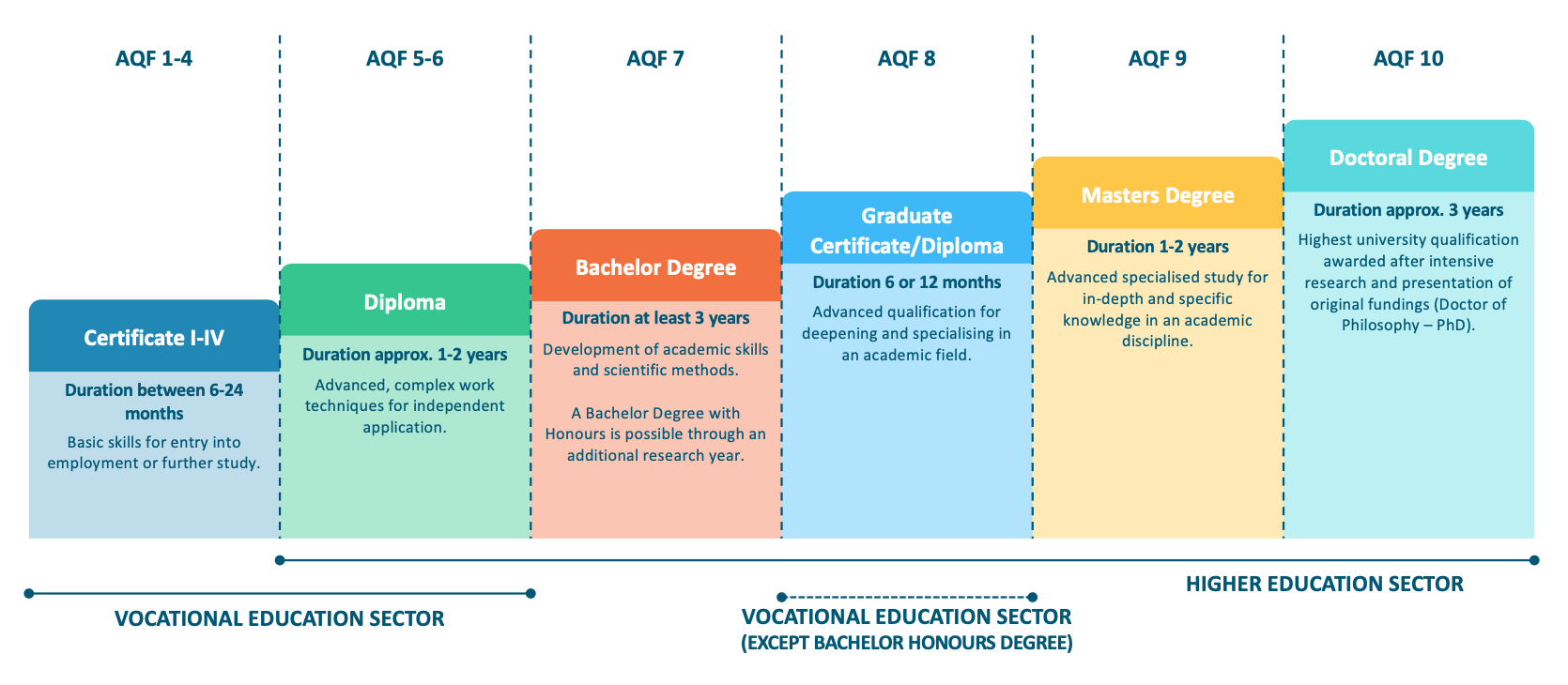
The structured, modular system also benefits career changers without a high school diploma. Many vocational colleges have lower entry requirements and recognise prior work experience to access higher-level courses.
02 VET course or Higher Education – which is right for me?
You can study in Australia not only at universities but also at practical TAFE colleges or private vocational institutes.
Your possible pathways include:
VET courses (Vocational Education and Training): practical, job-focused training such as hospitality, tourism, IT or design
University (Bachelor, Master): academic pathway with internationally recognised degrees
Combination of English course + training/degree: ideal if you want to improve your English first
There are also entry pathways for students without Abitur/Matura. Some courses only require Year 10; others accept work experience in place of formal school qualifications. Many courses have flexible intakes – quarterly or even monthly.
03 Costs and financing of studying in Australia
Many initially think of high university fees. However, vocational education (VET) is often more affordable. These practical courses are usually cheaper than university study and often include a Vocational Placement, sometimes paid.
A Student Visa also grants work rights. You can apply your skills and earn income. The allowed working hours are usually 48 hours per fortnight, with full-time work permitted during holidays. Pay rates are typically above the Australian minimum wage.
A full-time course usually requires 20–25 hours per week (including placement), allowing sufficient time to work alongside your studies. Some schools require only 3 on-campus days per week, and semester breaks often last up to 2 months.
04 Can I include my family in my Student Visa?
Yes. Your partner and minor children can be included in your Student Visa. You do not need to be married. As long as you can prove a genuine, ongoing relationship, your partner can be added. A major benefit: your partner also receives work rights (part-time or full-time, depending on the course).
05 How good does my English need to be for training in Australia?
Good English skills are important to follow classes and complete assessments. Requirements vary by course and provider. Some providers offer their own online tests, while others require recognised tests such as IELTS or PTE.
If your English is not yet strong, you can simply combine your training with an English course – for example an ELICOS (English Language Intensive Courses for Overseas Students). Options range from General English to Academic English. More information is available on our language course page.
06 Can I stay in Australia longer after finishing my course?
Studying in Australia alone does not automatically grant access to another visa. The Student Visa is valid only for the duration of your course (plus a short buffer period).
If you wish to stay longer, you need a new visa. The right visa depends on your plans. For holidays, an onshore Visitor Visa may work. For working or staying longer, you must check which work visa options may apply.
The pathway to Permanent Residency after studying does not always have to run through the classic skilled visas. If you meet a partner in Australia before or during your studies, a Partner Visa pathway may also be possible.

YOUR PATHWAY
TO AUSTRALIA
Whether it’s a high school year, a short stay with an English course or vocational training as the basis for a fresh start in Australia – good planning and preparation are essential. Having a strong and experienced partner at your side is key. Our experts specialise in the Australian education system and visa regulations. We understand the various requirements and show you the best pathway tailored to your individual needs.

LET’S KEEP IN TOUCH
Want regular updates about living and working in Australia and New Zealand?
Simply subscribe to our newsletter.
You’ll receive our regular updates. You can unsubscribe at any time.